
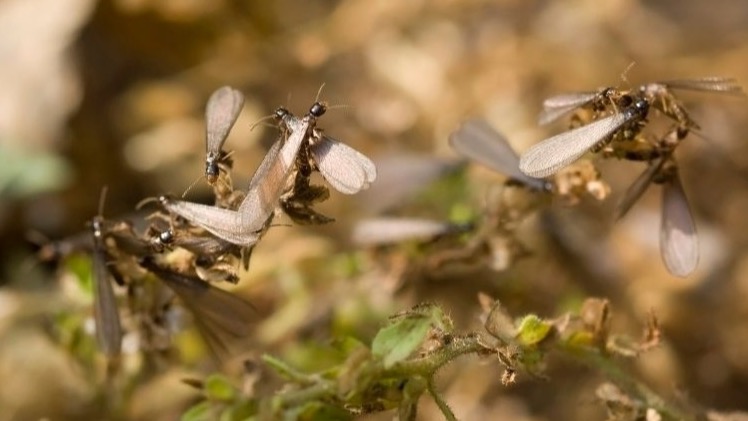
If you have ever stepped outside after an Arizona monsoon storm and found yourself walking through a cloud of winged insects, you have probably witnessed a termite swarm. It is one of the more dramatic pest events Phoenix area homeowners encounter, and it raises an immediate question: does this mean my home has termites? The good news is that the answer is not necessarily “Yes!,” but the longer answer is nuanced, and understanding what the swarm means for your home requires knowing a little about how termites live, reproduce, and respond to the conditions Arizona’s monsoon season creates.
At Nectar Pest Control, we field more calls about termite activity during and after monsoon season than at any other time of year. Here is a straightforward explanation of what is actually happening when termites swarm, what it means for your home, and what steps you ought to consider taking in response.
What a Termite Swarm Actually Is
A termite swarm is a reproductive event, not a feeding event. The insects you see flying are called alates — winged reproductive termites produced by mature colonies specifically for the purpose of mating and establishing new colonies elsewhere. They are not workers, and they are not foraging for wood. They are on a one-time flight that, for the vast majority of individual insects, ends without success. Alates are poor fliers, most are eaten by birds and lizards within minutes of emerging, and only a tiny fraction will successfully pair, find suitable soil, and establish a new colony.
Termite alates are frequently confused with winged ants, which also swarm in response to monsoon conditions. The differences are visible to the naked eye. Termite alates have straight antennae, a broad waist with no pinch between thorax and abdomen, and two pairs of wings of equal length extending well beyond the body. In contrast, winged ants have elbowed antennae, a distinctly pinched waist, and wings of unequal length. However, both shed their wings after landing, leaving small piles of discarded wings near the swarming site.
Why Monsoon Rains Trigger Termite Swarming
Subterranean termites are highly sensitive to environmental conditions, and the timing of their reproductive swarms is not random. It is initiated by a specific combination of warmth, humidity, and soil moisture that the monsoon season delivers reliably every year. Arizona’s pre-monsoon months are hot but extremely dry, and dry soil conditions suppress swarming. When monsoon rains saturate the soil, moisture levels shift dramatically within hours, signaling to mature colonies that conditions are favorable for reproductive flight.
Swarms in Arizona most commonly occur in the evening hours following afternoon thunderstorms, when temperatures have moderated from peak afternoon heat and humidity is elevated from recent rainfall. The desert subterranean termite (scientific name Heterotermes aureus) is the species most closely associated with monsoon swarming in the Phoenix area and is considered the most economically impactful termite species in Arizona due to its abundance and capacity for structural damage.
Does a Swarm Mean Your Home Is Infested?
As stated above, while a swarm does not necessarily mean your home is infested, it does indicate that it may be. Finding a swarm outdoors near your home means active termite colonies are present somewhere in your immediate area. But even though it does not confirm that your structure is being actively fed on, it does clearly signify that termites capable of doing so are nearby.
Finding alates inside your home is a more significant indicator that you do have a problem. If winged termites are emerging from baseboards, window frames, or door frames, it suggests a colony is present within or immediately adjacent to the structure. Alates do not travel far once they are indoors, and interior swarms almost always originate from a colony that has already established access to the building.
Discarded wings near window sills or baseboards, mud tubes along foundation walls, and wood that sounds hollow when tapped are the three most important signs to look for after a swarm event. Mud tubes, the narrow earthen tunnels about the diameter of a pencil, are the most definitive evidence of subterranean termite activity and appear along foundations, plumbing penetrations, and anywhere soil contacts or approaches structural wood.
Why Post-Monsoon Is the Right Time to Inspect
Termite colonies are most active in the warm, moist soil conditions that monsoon season amply provides. Feeding activity that has been suppressed by dry spring and early summer conditions accelerates when soil moisture increases. Evidence of infestation is more likely to be visible and detectable during this period than at any other time of year.
The reason this is significant, and even helpful, is because most termite damage discovered in Arizona homes represents years of undetected feeding. A colony that causes meaningful structural harm can be quietly doing its destructive work long before monsoon season arrives. It may even have arrived years earlier and continued foraging while the homeowner remained unaware. That swarm may be your warning system, telling you to get your home checked out, whether it’s to find nothing and take steps to prevent infestation, or to discover a problem and have it taken care of.
Remember: standard homeowner’s insurance policies in Arizona do not cover termite damage because it is categorized as a preventable pest issue. Accordingly, the financial case for early proactive investigation is straightforward.
What Homeowners Can Do to Reduce Risk
Wood-to-soil contact is the most significant risk factor for subterranean termite access. Any situation where structural wood, grade stakes, wood mulch, or wood debris directly contacts soil creates a pathway termites can exploit without building visible mud tubes. Keeping mulch pulled back from the foundation and removing wood debris from beneath decks and porches are practical steps with real impact.
Moisture management around the foundation matters as well. Leaking irrigation heads, air conditioner condensate lines draining against the foundation, and poor drainage that keeps soil consistently wet near the structure all create favorable termite habitat directly adjacent to your home. Correcting these conditions removes one of the primary attractants without requiring any chemical treatment.
Ready to Find Out Where Things Stand?
If you have seen swarming activity near your home this monsoon season, found discarded wings indoors, or cannot remember the last time your home was professionally inspected, now is an ideal time to schedule an assessment.
Nectar Pest Control serves homeowners throughout Phoenix, Mesa, Scottsdale, Chandler, Gilbert, and the surrounding Valley communities. Our inspections assess your property for evidence of current activity for termites or any other pests, identify conditions that increase risk, and propose treatment options appropriate for your specific situation.
Call us today at 480-739-3000 or visit our website to schedule an inspection for a free quote. Monsoon season makes termite activity more visible, so take advantage of that signal to find out if you are at risk. Ask Nectar Pest Control about our 25% off summer sale, available until the end of August.