
Most Arizona homeowners know termites are a threat; however, not all of them know when to actually do something about it. That gap between awareness and action is where termite damage accumulates, and it can cause significant — and costly — damage to your home.
Unlike a scorpion in the bathroom or a cockroach in the kitchen, termite activity rarely announces itself with an “Eeeek!” moment. Instead, it develops slowly, invisibly, and often for years before any sign reaches the surface. By the time a homeowner notices something worth investigating, the damage underneath is usually considerably more extensive than what is manifested visibly.
At Nectar Pest Control, we help Phoenix-area residents address all types of pest problems, from ants and crickets all the way to rodents, scorpions, and termites. Understanding when a termite inspection is warranted — and why the timing matters as much as the inspection itself — gives Arizona homeowners a more useful framework than simply waiting for obvious signs before calling a professional. Here are some facts you should know about the termite issue in this region.
Why Arizona Is One of the Highest-Risk Termite Markets in the Country
Termite risk is not evenly distributed across the United States. Unfortunately for Arizona residents, it is concentrated in the Southwest, and Phoenix sits near the center of that concentration. The desert subterranean termite (Heterotermes aureus) is the species most common to the Sonoran Desert region and the primary cause of structural termite damage in the Phoenix metro area. It is active in the soil year-round, forages aggressively, and is triggered to swarm by the moisture and heat conditions that monsoon season delivers reliably every summer.
Unlike other termite species that live in cooler climates and go dormant during winter months, desert subterranean termites maintain foraging activity in Arizona’s warm soil throughout the year at varying levels. There is no dormant season that gives homeowners a natural window of reduced risk. The question for Phoenix area homeowners is not whether termites are active in their vicinity (they almost certainly are), but whether those termites have found or are working toward access to their structure.
5 Cases In Which an Immediate Inspection Is Warranted
Certain situations make a termite inspection not just advisable but urgent. If you are in any of the following circumstances, scheduling a professional inspection should happen promptly rather than at your convenience.
- You witnessed a termite swarm near or inside your home. Swarming termites — the winged reproductive alates that emerge in large numbers following monsoon rains — are the most visible sign that mature termite colonies are active in your immediate area. Finding a swarm outdoors near your home’s foundation confirms colony presence nearby. Finding swarming termites or discarded wings inside the home is a stronger indicator that a colony has already established access to your home’s structure. Either situation warrants prompt professional assessment.
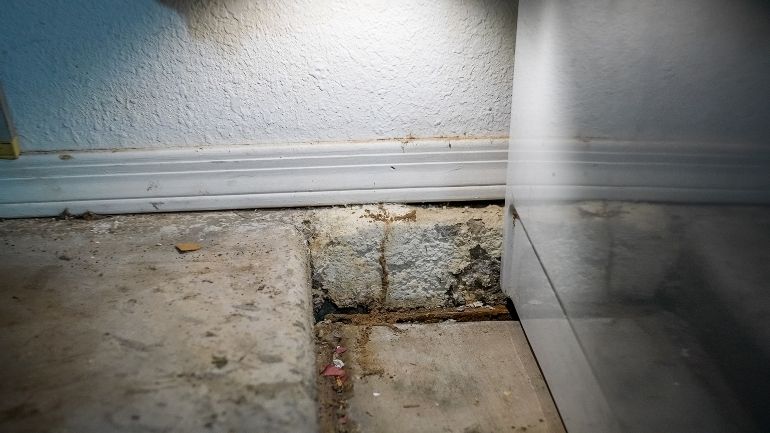
- You have found mud tubes on or near your foundation. Mud tubes are the pencil-width earthen tunnels that subterranean termites construct as protected travel routes between the soil and the wood they are feeding on. They appear along foundation walls, interior stem walls, garage walls, and anywhere soil contacts or approaches structural wood. A mud tube is not a sign that termites might be present — it is confirmation that they are or recently were. An intact tube with live insects inside indicates active infestation. A broken tube that is repaired within a few days when you check it again confirms ongoing activity. Even a dry, empty tube warrants professional evaluation to determine whether the infestation is current or past.
- You have found wood that sounds hollow or feels soft in areas adjacent to the foundation or soil contact points. Subterranean termites feed from the inside out, consuming the soft interior of wood while leaving an often-intact outer surface. Tapping structural wood near the foundation with a screwdriver handle and hearing a hollow response, or probing it and finding the surface gives way more easily than it should, can reveal feeding damage that is not visible externally. Window and door frames, baseboards near exterior walls, wood framing in garage areas, and any structural member near soil contact are the locations most worth checking.
- You are purchasing a home. A termite inspection before closing is one of the most valuable investments a buyer can make in the Phoenix market. Standard home inspections do not always include a dedicated termite assessment, and a general inspector may not have the species-specific expertise to identify early termite evidence that a licensed pest control professional would recognize immediately. Home inspectors do not have access to what is in your walls; although they will check your subfloor and attic, they are primarily looking for issues that are visible to the naked eye. Purchasing a home without a dedicated termite inspection in Arizona is accepting an unknown level of risk that a relatively inexpensive inspection can eliminate.
- Your neighbor has had termite activity. Termite colonies forage through underground tunnel networks that can extend significant distances from the colony center. A confirmed termite infestation in a neighboring property does not mean your home is infested, but it does mean active colonies are operating in the soil adjacent to your structure. Inspecting your own property after learning of a neighbor’s infestation is a reasonable proactive step.
Cases Where an Inspection Makes Sense Even Without Obvious Signs
Beyond the clear-cut situations above, there are circumstances where a termite inspection is warranted even in the absence of visible evidence. These include when:
- Your home has never been professionally inspected for termites. In Arizona, this is reason enough to request an inspection. The Sonoran Desert’s termite population is dense, the species active in the region are aggressive foragers, and homes with no history of professional termite monitoring are homes with an unknown status rather than a clean one. An initial inspection establishes a baseline, either confirming that no current activity is present or identifying conditions that need to be addressed.
- It has been more than a year since your last professional inspection. Annual termite monitoring is the appropriate standard for most Phoenix area homes, and the rationale is straightforward: termite activity that was not present at your last inspection could have begun since then. Conditions that increase termite risk (wood-to-soil contact, moisture accumulation near the foundation, a new crack along the stem wall) can develop between inspections. A once-yearly professional walkthrough catches developing conditions before they become established infestations.
- You are planning a remodel or addition. Construction activity that disturbs soil adjacent to the foundation, exposes structural wood, or introduces new wood-to-soil contact points creates conditions that termite colonies can exploit. A pre-construction termite inspection identifies existing activity before it is complicated by construction, and a post-construction inspection confirms that new work has not introduced vulnerability.
- You have had prior termite treatment. A home that has been treated for termite activity in the past is not permanently protected. Liquid soil treatments have finite residual effectiveness that decreases over time. Bait systems require ongoing monitoring and maintenance to remain effective. A prior treatment history is not a reason to skip future inspections; it is a reason to maintain them, since the colony pressure that prompted the original treatment has not disappeared from the surrounding soil.
- Monsoon season has just passed. The combination of heat and moisture that monsoon season delivers is the primary termite swarming trigger in Arizona, and it also accelerates foraging activity in established colonies. The post-monsoon period (September through October) is one of the best times of year to inspect, because evidence of activity that has been building through the summer is more likely to be visible than at other points in the year.
What a Professional Termite Inspection Actually Covers
A thorough termite inspection assesses both the interior and exterior of the structure with termite-specific knowledge guiding where to look and what to look for. Exterior inspection covers the foundation perimeter, block walls, garage walls, eave areas, wood elements in contact with or near soil, and any conditions, such as moisture accumulation, wood debris, landscaping in contact with the structure, that increase termite access risk. Interior inspection covers baseboards, window and door frames, areas beneath flooring where accessible, wall junctions, and any locations where prior activity has been documented.
Your inspector is not simply looking for live termites. They are looking for the full range of evidence that indicates current or historical activity: mud tubes in various states of activity, damaged wood, frass deposits, discarded wings, conditions that increase risk, and the absence of prior treatment indicators in a home where treatment history is unknown. That comprehensive assessment produces a more useful picture than a homeowner’s visual inspection of accessible surfaces.
Ready to Schedule Your Inspection?
Whether you have seen specific signs of termite activity, are approaching the anniversary of your last inspection, or simply cannot remember the last time your home was professionally assessed, now is a reasonable time to act.
Remember, standard homeowner’s insurance policies in Arizona do not cover termite damage, classifying it as a preventable pest issue rather than a sudden loss. That means that the cost of repairing any damage your home suffers from termites will have to be covered by you, and late discovery of a termite problem can easily run into thousands of dollars. The cost of uncovering termite activity and addressing it early is a fraction of the cost of finding it late.
If you are concerned about termite issues either because you have discovered potential termite presence or your home is due for an inspection, call Nectar Pest Control today to schedule a cost-free inspection. We serve homeowners throughout Phoenix, Mesa, Scottsdale, Chandler, Gilbert, and the surrounding Valley communities. Our inspections assess your property for current activity, historical evidence, and conditions that increase termite risk — giving you an accurate picture of where things stand and what, if anything, needs to be done.
In Arizona’s termite environment, knowing where you stand is always better than finding out the hard way.